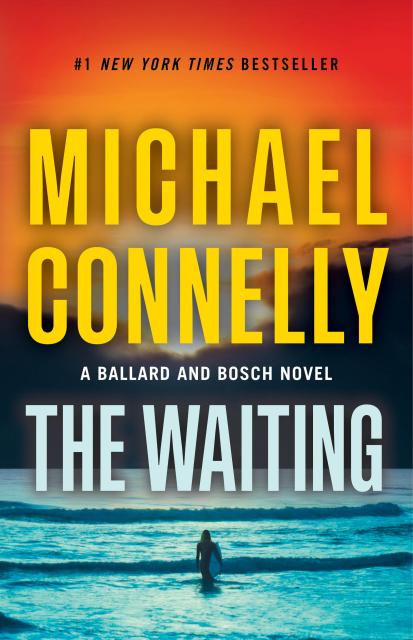
The Waiting
A Ballard and Bosch Novel

Contributors
Formats and Prices
- On Sale
- Oct 15, 2024
- Page Count
- 416 pages
- Publisher
- Little, Brown and Company
- ISBN-13
- 9780316563796
Price
$30.00Price
$39.00 CADFormat
Format:
Buy from Other Retailers:
Renée Ballard and the LAPD’s Open-Unsolved Unit get a hot shot DNA connection between a recently arrested man and a serial rapist and murderer who went quiet two decades ago. The arrested man is only twenty-four, so the genetic link must be familial: His father was the Pillowcase Rapist, responsible for a five-year reign of terror in the City of Angels. But when Ballard and her team move in on their suspect, they encounter a baffling web of secrets and legal hurdles.
Meanwhile, Ballard’s badge, gun, and ID are stolen—a theft she can’t report without giving her enemies in the department ammunition to end her career as a detective. She works the burglary alone, but her mission draws her into unexpected danger. With no choice but to go outside the department for help, she knocks on the door of Harry Bosch.
At the same time, Ballard takes on a new volunteer to the cold case unit: Bosch’s daughter Maddie, now a patrol officer. But Maddie has an ulterior motive for getting access to the city’s library of lost souls—a case that may be the most iconic in the city’s history. Complex, satisfying, and full of dexterous twists, The Waiting demonstrates once more that “you can’t do better than Michael Connelly” (Forbes).
Genre:
-
“The Waiting is a milestone of sorts for Bosch…He is a complicated, maddening, impulsive, brilliant, beautifully drawn character. Connelly’s books are gripping, with a momentum that starts on the first page and builds steadily to the last. And he describes Los Angeles as well as any writer ever has.”Los Angeles Times
-
"Despite having to navigate the byzantine politics of the city’s justice system, including meddling higher ups and an intransigent prosecutor, Ballard and her team ultimately win the day. The multiple plot lines are suspenseful and unfold at a torrid pace, and as usual in a Connelly novel, the prose is tight and the characters are compelling and well-drawn. The Waiting is the habitually best-selling author at the top of his game.”Bruce DeSilva, Associated Press
-
"Michael Connelly is a powerhouse, an unstoppable force in crime fiction. The Waiting is proof he is at the top of his game."Mick Herron, #1 bestselling author of Slow Horses
-
“Connelly’s sixth book featuring Renée Ballard provides a welcome look at her backstory that allows for a more nuanced portrayal of the gritty detective.”Washington Post
-
"Unputdownable . . . White-hot suspense guaranteed to please his fans. This ranks with Connelly's best."Publishers Weekly (starred)
-
“A Hawaiian coda provides the best news of all: This distinguished series has plenty of miles to go. Aloha, and hooray.”Kirkus Reviews
-
“The Waiting is a delight from start to finish and another example of classic Connelly…. I was literally sweating as I read these tense scenes.”Bookreporter.com
You May Also Like



What's Inside
The Waiting
MONDAY, 7:28 A.M.
1
SHE LIKED WAITING for the wave more than riding the wave. Facing the cliffs, straddling the board, her hips finding the up-and-down rhythm of the surface. Riding it like a horse, making her think about Kaupo Boy when she was a child. There was a reverence to the moment before the next set came in and it was time to dig down and paddle.
She checked her watch. She could fit in one more. She’d ride it all the way in if she could. But she savored the moment of just floating, closing her eyes and tilting her head upward. The sun was just over the cliffs now and it warmed her face.
“Haven’t seen you here before.”
Ballard opened her eyes. It was the guy on the One World board. An OG with no wetsuit, no leash, his skin burnished to a dark cherrywood. She braced for what she knew would come next: territorial male posturing.
“I’m usually at Topanga,” she said. “But there was nothing there this morning.”
She didn’t mention that she’d consulted a wave app. The OGs would never look at an app.
He was twenty feet to her left, riding the low rollers sideways so he could keep an eye on her. Women were unusual at Staircases. It was a big boy’s break. Lots of rocks in the short tide. You had to know what you were doing, and Ballard did. She hadn’t crossed anybody’s tube, had not pulled out of a wave too soon. If this guy was going to try to school her, she would shut him down quick.
“I’m Van,” he said.
“Renée,” she said.
“So, you wanna get breakfast at Shoreline after?”
A little forward, but okay.
“Can’t,” she said. “Got one more set and then I got a job. But thanks.”
“Maybe next time,” Van said.
Before the conversation got more awkward, somebody farther down the line began paddling, aligning his board with an incoming wave. It was like a bird startling and jumping the whole flock into flight. Ballard checked over her shoulder and saw the next set coming in tall. She flipped forward and brought her legs up on the board. She started paddling. Deep strokes, fingers together to get speed. Digging down. She didn’t want to miss the wave, not in front of Van.
She glanced to her left and saw him paddling stroke for stroke with her. He was going to press her, show her whose break it was.
Ballard paddled harder, feeling the burn in her shoulders. The board started to rise with the wave and she made her move, jumping up into a crouch on the center line. She put her left foot behind her and stood just as the wave crested. She pushed the nose down and began slicing down the face of the wave.
She heard Van’s voice in the wake, calling her goofy foot.
She put her hands out for balance, heeled the board into a turn, and went up the wall before cutting it back down and taking it all the way in. For eight seconds everything about the world was gone. It was just her and the ocean. The water. Nothing else.
She was coasting on foam when she remembered Van and looked back for him. He was nowhere in sight and then his head came up in the surf along with his red board. He raised his hand and Ballard nodded her goodbye. She stepped off, lifted her board, and walked out of the surf.
She had her wetsuit stripped down to her hips by the time she rounded the dunes and got to the parking lot. The combination of sun and wind was already drying her skin. She leaned her board against the side of the Defender and reached under the rear wheel well for her key box.
It was gone.
She crouched down and looked at the asphalt around the tire for the magnetic box.
It was not there.
She leaned in, looking up into the well, hoping she had set the box in the wrong spot.
But it was gone.
“Fuck.”
She quickly got up and went to the door. She pulled the handle and the door opened, having been left unlocked.
“Fuck, fuck, fuck.”
There was the key and the magnetic box on the driver’s seat. She saw that the glove compartment was open. She leaned in, reached under the driver’s seat, and swept her hand back and forth on the carpet.
Her phone, gun, wallet, and badge were gone. She swept her hand farther under the seat and pulled out her handcuffs and a seven-shot Ruger boot gun that the thief had apparently missed.
She stood up and looked around the parking lot. No one was there. Just the row of cars and campers belonging to the surfers still out on the water.
“Fuck me,” she said.
2
WITH HER WALLET containing her ID card stolen, Ballard could not pass through the turnstile at the entrance of the LAPD’s Ahmanson Center, so she drove into the overflow lot behind the massive training center and called Colleen Hatteras on her new phone. Hatteras answered with an urgent tone.
“Renée, where are you? Wasn’t the unit meeting at nine?”
“I’m in the back lot. I want you to let me in the fire exit, Colleen.” “Are you sure? If the captain — ”
“I’m sure. Just open the door and I’ll deal with the captain. Is everyone still there?”
“Uh, yes. I think Anders went to the cafeteria but he didn’t say anything about leaving.”
“Okay, tell Tom or Paul to get him while you open the door for me. I’ll be there in two.”
“Well, what happened? You didn’t call and didn’t answer our calls. We were starting to get worried.”
Ballard got out of the Defender and headed to the back door of the complex. She was already exasperated with Colleen and the day hadn’t even started.
“Calm down, Colleen,” she said. “Everything’s fine. I lost my phone and wallet at the beach. I had to go home to get a credit card and then hit the Apple Store to get a new phone. So please just open the door. I’m almost there and I’m hanging up now.”
She disconnected before Colleen could respond, which Ballard knew she would. She walked up to the fire exit, pulling her jacket closed so maybe it would not be obvious that she had no badge clipped to her belt.
Colleen opened the door and an ear-piercing alarm sounded. Ballard quickly stepped in and pulled the door closed, and the sound cut off.
“How did you lose your phone and wallet? Were they stolen?” “It’s a long story, Colleen. Is everyone here?”
“Tom went to get Anders.”
“Good. We’ll start as soon as they’re back.”
The fire exit was located behind the murder-book archive. Leading Colleen, Ballard walked the length of the back row of shelves and into the bullpen of the Open-Unsolved Unit. The center of this area was dominated by the “raft” — eight interconnected desks with privacy partitions between them. The side walls of the bullpen were lined with file cabinets and mounted whiteboards on which current investigations were tracked.
“Sorry I’m late,” Ballard announced as she reached her desk at the end of the raft. “As soon as Tom and Anders are here, we’ll start.”
Ballard sat down and logged into her city computer terminal. She went through the department’s password portal and pulled up the database containing crime reports from the entire county. She searched for reports on thefts from vehicles at county beaches and soon was looking at several occurrences. From this she was able to cull a list of thefts that had occurred at popular surfing beaches. From Trestles up to Dockweiler, Ballard had been surfing the Southern California coastline since she was sixteen years old. She knew every break and could see a pattern of BFMV—burglary from motor vehicle—reports occurring at places where she knew the parking facilities weren’t visible from the ocean.
This told her three things. First, this was likely the same thief or group of thieves. Second, they were familiar with surfing and probably were surfers themselves. And third, because the thefts were spread out up and down the coast and across multiple police jurisdictions, the pattern had not been noticed by law enforcement. The thefts were seen as individual crimes.
Ballard started reading the summaries of the reports to see if any witnesses had seen anything helpful, if any suspects’ fingerprints had been found, or if there was any follow-up to the initial reporting of the crimes. None of the thefts were large enough to warrant much interest from law enforcement. Wallets, phones, cash, and spare surfboards were the things most often stolen. Taken separately, Ballard knew, these cases likely died with the initial report. As protocol dictated, they would go to an auto-crimes desk somewhere, but without a description of a suspect, a fingerprint, or even a partial license plate of a getaway car, the reports would go into the great swirling maw of minor crimes that did not merit much attention from the criminal justice apparatus. It was the story of the modern age. Reports were taken largely for insurance purposes. As far as law enforcement went, it was a waste of paper.
Colleen stuck her head over the half wall separating Ballard’s desk from her own. From her angle, she could not see Ballard’s screen. “So, what are you working on?” she asked.
Ballard logged out of her search. “Just checking email,” she said. “Is everybody ready?”
“Anders is here,” Colleen said. Ballard stood up to address the team.
3
OTHER THAN BALLARD, who was a full-time sworn officer, the members of the Open-Unsolved Unit were all volunteers. Two years ago, following a law enforcement trend that had budget-challenged police departments across the country using retired detectives to investigate cold cases, Ballard had been placed in charge of the LAPD’s previously mothballed unit. She was also its chief recruiter, which meant that she had to convince people to contribute their skills to the noble effort at least one day a week, with fifty dollars a month to cover expenses. She had finally reached a point where she was happy with the squad she had curated.
Gathered at the raft were Tom Laffont, retired FBI; Lilia Aghzafi, who had done twenty years with Vegas Metro; and Paul Masser, formerly a prosecutor with the district attorney’s office. Colleen Hatteras had never been a police officer. She had been a stay-at-home mom who got hooked on genetic genealogy and took online courses in its application to law enforcement. She was a relentless warrior at the keyboard—and at butting into the personal lives of the other members of the team, with a primary focus on Ballard. She was also a self-described empath who never shied away from expressing the feelings she picked up from people. Ballard reluctantly put up with this because of Colleen’s case-related skills.
The newest member of the unit was Anders Persson, who was even more of an outlier than Hatteras. His law enforcement experience was limited to volunteer work with the Swedish Police Authority in his hometown of Stockholm. But Persson, just twenty-eight years old, now ran an L.A.-based software company by night and assisted the OU team by day. While Hatteras was the expert in hunting down family histories and genetic connections, Persson was the go-to guy when it came to navigating the internet and finding people who had gone to extreme lengths to avoid being found. Together, Hatteras and Persson were a formidable team that complemented those on the unit with real police and investigative experience. And while the unit and Ballard were still recovering from a major hit to their reputations, the result of an early case that had gone awry, Ballard felt the team was now humming like a well-tuned motor. The raft had room for two more volunteers, but Ballard was satisfied with what they were accomplishing. The unit cleared, on average, three cold-case murders a month. It was a drop in the bucket compared to the six thousand unsolved murder cases stored in the archive shelves behind the raft, but it was a solid start.
Ballard stepped over to the whiteboard wall to begin the meeting. Normally she would have left her suit jacket draped over her chair, but today she kept it on to hide the fact that she didn’t have her badge.
Four side-by-side boards were used to track the cases that were in some level of play. Every Monday morning, the team gathered to discuss their progress. The first board listed all cases that contained evidence to be submitted for forensic and technological analyses. This primarily meant DNA, fingerprints, and, sometimes, ballistics. The application of DNA in criminal prosecutions had not been approved by the California courts until the early 1990s, and genetic analysis had taken major strides forward in recent years. This made unsolved cases from the last three decades of the previous century fertile ground for review. Additionally, fingerprint databases had greatly expanded. The ballistics databases lagged behind these advances and were not as useful, but in gun cases they couldn’t be ignored.
What put sand in the gas tank of the unit’s well-tuned motor was that many of the cases were so old that the killers the team identified were already dead or incarcerated. This brought answers to still grieving families, but it felt like justice that was too little too late. And the members of the Open-Unsolved team were denied what every investigator wanted and needed at the end of a case: the opportunity to confront the evil behind the murder. This was why so-called live cases — where the killer was believed to be living and still out there—were the investigations the team rallied behind. Though the archive contained records of unsolved cases going back to the early 1900s, Ballard directed the team to work only on cases recorded since 1975.
Ballard scanned the first board to see if any new cases had been added. Every team member was charged with pulling cases from the archive and reviewing them for possible follow-up when not working on a current investigation.
“Okay, anybody add anything new to our in-play list?” she asked.
After a round-robin of negative responses from the raft, Laffont raised his hand. “I think I’ll have one to add this week,” he said. “Expecting to hear something back from Darcy today — if I’m lucky.”
Darcy Troy was the DNA tech who handled cases from the Open-Unsolved Unit. It was good to have a go-to person at the lab, but Troy was not assigned solely to OU cases. Current investigations were always a priority, and Troy had to handle DNA analysis from those cases ahead of anything that came in from the raft. Sometimes the wait was frustrating.
“What’s the case?” Ballard asked.
“A sexual assault and murder from ’91,” Laffont said. “A bad one.
Not that there are any good ones, but the guy assaulted her several times before he strangled her. Ejaculated outside the body but left something behind on her clothes. Darcy took it. Last week she said she’d have something this week.”
“Good,” Ballard said. “What’s the vic’s name?”
“Shaquilla Washington,” Laffont said. “A south-end case. Didn’t get much attention in the day.”
Ballard nodded. It went without saying that the archives were disproportionately heavy with cases that hadn’t gotten much attention because they were from minority communities on the city’s south and east sides. This could in part be due to the fact that there were more murders in these communities and the detective workloads there were the heaviest in the city. But it could also be explained by a lack of commitment to those communities and an absence of empathy for the victims. Ballard had noticed neither of those deficiencies in Laffont. When he had the time to go into the archives and pull cases for review, he often looked for reports from the south side. He was white and in his late fifties and had seldom worked on the south side as an FBI agent assigned to the Los Angeles field office; he saw his efforts now as a way to partly balance the scales. Ballard respected him for that.
“Hopefully Darcy comes through with something,” Ballard said.
She continued reviewing the boards and the cases with her crew, eventually coming to the last board, which listed the cases that were most active in terms of pending arrests, prosecutions, or closures. The last case on the list belonged to Masser.
It involved the murder of a clerk at a Hollywood convenience store in 1997. A man in a ski mask entered the store, told the clerk to put all the cash in the register on the counter, and fired a shot into her chest, killing her instantly. The man then jumped into a waiting car and escaped. According to various witnesses from inside and outside the store, the getaway driver was a white woman with long black hair.
The car was described as a maroon sedan, and one witness provided the first two digits of its license plate.
There was a video camera inside the store, and a review of the tape revealed that the gun was fired while the suspect was gathering the cash the clerk had put on the counter. It appeared to be an accidental discharge that shocked even the gunman; he turned and ran out of the store, leaving half the cash behind.
The license plate digits and car description eventually led investigators through motor vehicle records to a man named Donald Russell, who owned a maroon Honda Accord with a license plate beginning with those two digits. Russell was unemployed and had a history of drug-related arrests. He lived with his wife, who also had a record of drug arrests. She, however, had short blond hair. Both were questioned but denied involvement in the robbery and killing. They provided an alibi that the investigators could neither prove nor disprove. The detectives took the case to the district attorney’s office but prosecutors declined to file charges, saying there was not enough evidence to convince a jury and bring home a guilty verdict. But no further evidence was developed, and the case went cold — until Paul Masser of the Open-Unsolved Unit pulled the murder book off a shelf in the cold-case archive.
Masser reviewed the case and quickly learned that it didn’t have the traditional kind of evidence that could jump-start a cold case. There were no fingerprints or DNA from the crime scene. The bullet had been collected from the fallen clerk’s body, but it did not lend itself to modern ballistic technology because it had flattened when it hit the victim’s spine, which made it useless for comparison with bullets in NIBIN, the national ballistics database. And no weapon had ever been recovered to compare the bullet with.
Masser located the suspects, still living in Los Angeles, and learned two things that could prove useful a quarter century after the killing. The first was that the couple were no longer a couple; they had divorced five years after the murder. The second, which he discovered through social media, was that the now ex-wife, Maxine Russell, was a recovering addict who had recently celebrated twenty years of sobriety, according to her Facebook page.
Masser, drawing on his experience as a prosecutor, knew that the couple’s divorce meant that statutory spousal privilege was no longer in play. The rule held that a wife or husband could not testify against a spouse without that spouse’s approval. But the protection was limited to the years of the marriage, which meant there was an opportunity to pit the former husband and wife against each other. Masser, drawing on his experience with an addicted family member in recovery, also knew that most rehab programs encouraged participants to keep journals as part of their steps toward sobriety.
With information gathered in the original investigation, Masser drew up a search warrant for the apartment where Maxine Russell now lived and convinced a judge to sign it. The warrant included all journals and documents written by the suspect as well as family photos that showed Maxine with long dark hair. On a shelf in the living room, Masser found several journals Maxine had kept over the years of her sobriety. One entry described the robbery gone wrong and another expressed Maxine’s guilt at having been involved in the taking of a life, even though she claimed it had been an accident. Additionally, a photo album found in a closet contained photos of Maxine going back to when she was a child. In many, she had long dark hair.
Maxine had been arrested two weeks ago and was still in jail, unable to afford a bond on bail set at two million dollars. The department low-keyed the arrest and it had so far escaped media attention. It was now time for Masser to move forward with the second part of the case strategy.
“I’m going to meet with John this afternoon,” Masser told the group. “We’re going to go to Maxine’s lawyer and see if she wants to deal. After two weeks, she is probably getting the idea that incarceration is not how she wants to spend the rest of her life.”
John was John Lewin, the deputy DA assigned to prosecute cases from the Open-Unsolved Unit. In the news coverage that solved cold cases often brought, the local media had dubbed him “the King of Cold Cases.”
“Has she called her ex-husband from the jail?” Ballard asked.
“Not on the recorded lines,” Masser said. “I doubt he knows she’s been arrested.”
“What’s John going to offer her?” Laffont asked.
“I don’t know where he’ll start but he told me he’ll go to full immunity,” Masser said, “if she delivers the ex.”
“And you think she’ll go for it?” Laffont said.
“Yeah, I do,” Masser said. “I tried to pull the divorce file but it’s sealed. But twice since the divorce, she’s asked for restraining orders against him. It doesn’t look like she has a whole lot of love for him anymore. She’s going to flip.”
“Hope so,” Ballard said. “Let me know when you know.”
“Roger that,” Masser said.
“Okay, then, that’s it,” Ballard said. “Sorry I was late and I appreciate everybody sticking around. Let’s dig down and make cases.” Ballard always ended the weekly meeting with the same message, taken from a Muse song she loved: “Dig down.” The words were on a sign on the wall of her pod. It was her code when it came to both life and cases.
4
BACK AT HER desk, Ballard pulled up one of the crime reports she had reviewed earlier. This one was for a car burglary that had occurred at the Topanga break a few months ago. What drew her back to it was the officer’s note in the summary that there had been a fruit vendor in the parking lot where the theft occurred. The vendor said he had seen nothing but the officer had taken down his name and phone number for follow-up. Ballard copied the information about the fruit vendor and the victim of the theft into a small notebook. The victim was named Seth Dawson. He reported that in addition to his brand-new iPhone 15, a Breitling watch worth three thousand dollars, a gift from his father, had been taken. Those two items pushed the crime beyond petty theft and well into felony territory.
As she was putting the notebook back in her jacket pocket, Colleen poked her head up over the partition wall again.
“Did you forget something today?” she asked.
Ballard immediately thought about the staff meeting and wondered what she had possibly missed covering. “I don’t think so,” she said. “Like what?”
Colleen lowered her voice to a conspiratorial whisper. “Like your badge, for example.”
Ballard dropped her hand to her right hip as if to feel for the badge on her belt.
“Shit, you’re right,” she said. “It’s in my car under the seat. I’ll get it when I go out. Thanks for noticing, Colleen.”
“Anytime,” Hatteras said.
One of the two lines on Ballard’s desk phone started flashing. “Can you get that?” she asked Colleen.
“Sure,” Hatteras said.
She dropped from sight and answered the phone. Then she spoke to Ballard without poking her head over the partition. “It’s Darcy Troy on line one,” she said. “She said it’s important.”
Ballard punched the button and picked up the phone.
“Darcy, let me guess. Shaquilla Washington?”
“Shaquilla Wa—? No, it’s about something else. We just got a hot shot on the Pillowcase Rapist.”
Ballard said nothing as a cold finger slid down her spine. “Renée?”
“Yeah, sorry, I’m here. Where do they have him?”
“They don’t have him. It was a hit on the familial search you put in last year.”
“Tell me about it.”
“A guy was arrested by West Valley Division on a felony domestic.
His swab was taken and we sent it up to DOJ. It came back as a familial match in the Abby Sinclair case.”
It was one of the first cases Ballard had submitted for comparative genetic analysis after restarting the unit two years ago. The Pillowcase Rapist had terrorized the city for five years beginning at the turn of the century. Dozens of women were assaulted in their homes. Each had been sleeping and woke up as a pillowcase was pulled over her head, blinding her to her attacker. After the rape, he choked each victim into unconsciousness, hog-tied her with plastic snap ties, and escaped.
A task force was formed but no arrests were ever made. The reign of terror culminated in the murder of Abby Sinclair, the last known victim, in 2005. He went too far with Sinclair, choking her to death after the sexual assault. Following that, the attacks stopped, and the Pillowcase Rapist went dark.
“So it was a familial match,” Ballard said. “How close?”
“Very,” Troy said. “This guy who was arrested, he’s likely the Pillowcase Rapist’s son.”
Ballard nodded. She could feel her heart rate rising as adrenaline ticked into her blood. “How long ago was the arrest on the domestic?”
“Nine weeks ago.”
“Wow.”
“That’s how long it takes to process the arrest swabs and put them into the DOJ bank. These don’t get priority like DNA from crime scenes. Thank God you had that familial search in place.”
Ballard had joined the department and was in the academy and later in uniform patrol during the years that the Pillowcase Rapist had terrorized the city. She and her partner had been first on scene on the murder of Abby Sinclair. It was the first murder scene Ballard had ever been to. and although many followed, the image of Abby Sinclair’s naked body in her bed, the pillowcase pulled over her head, had stuck with her. It was the first case she’d pulled off the shelf in the library of lost souls — the murder-book archive.
“Okay, Darcy,” she said. “Give me what you’ve got on the domestic.”
Ballard wrote the information down, thanked Troy for the call, and hung up. She stood to see who was left on the raft. While the Monday-morning staff meetings were mandatory, the investigators were required to work only one day a week, and they often cleared out after the meeting, choosing to fulfill their commitment on other days. Ballard saw only Hatteras and Persson. She knew Aghzafi liked to work Thursdays or Fridays, and Masser had probably left to meet with the prosecutor and defense attorney on the Maxine Russell case. Laffont was nowhere to be seen, but Ballard hoped he had just stepped out for coffee or to go to the restroom, because she was going to need him.
“Okay, Anders, Colleen, listen up,” she said. “We’ve got a hot shot here I want to go full-court press on.”
She referred to her notes before continuing.
“I want you to run down a Nicholas Purcell, DOB January twenty-nine, 2000. He was arrested on a felony domestic about nine weeks ago in West Valley. I want to know everything about him: where he lives, where he works, the domestic, everything.”
“What’s the case?” Persson asked.
“About twenty years ago, there was a serial offender called the Pillowcase Rapist,” Ballard said. “He assaulted several women over a five-year run. I’m talking dozens of victims. He finally killed one and then dropped out of sight. He was never caught. That murder — that’s our case.”
“But wait,” Hatteras said. “If Nicholas Purcell was born in 2000, then he—”
“Can’t be our guy,” Ballard said. “That’s right, he’s not. It’s his father. We got a familial match. Purcell’s father is the Pillowcase Rapist. Through his son, we find him, get his DNA, and go from there.”
“Groovy,” Persson said.
Ballard looked at him for a moment, not sure what part of this the Swede thought was groovy. She chalked it up to English being his second language. She nodded and then started toward the archives, listening as she went to Hatteras and Persson discussing the division of labor on their assignment.
The cases in the archives were organized first by year and then alphabetically by the victims’ last names. Ballard had to crank the shelves open to access the 2005 cases. The Abby Sinclair murder book was actually a murder box. It contained records of the murder investigation and the forty-six sexual assaults that had begun in 2000. It was a cardboard box with handles. Ballard pulled it off the shelf and lugged it back to her desk.
Hatteras and Persson were both turned in their seats and waiting for her when she came out of the archives. Ballard could not yet read Persson as well as she could Hatteras after two years of working together. And her read of Hatteras now was that something was wrong.
“What?” she asked.
“Well, we found Nicholas Purcell,” Hatteras said. “We also think we have his father.”
“That was quick. What’s the issue?”
“Take a look.” Hatteras stood up to give Ballard access to her screen. Ballard put the murder box down on the seat and leaned on it to look at the screen. It was a photo on Nick Purcell’s Facebook page of a family gathered around a birthday cake.
“I scrolled back three years to find this,” Hatteras said.
“Okay, what am I looking at?” Ballard said.
“Read the caption,” Hatteras said. “This is Nick’s twenty-first birthday. That’s his father on the right.”
Ballard studied the father. She was hit with a slight glint of recognition, but she didn’t know where she would have known him from. He looked to be a fit fifty with a ruddy face and a full head of dark hair. He wore a striped golf shirt with sleeves stretched tight around his biceps.
“Who is he?” Ballard said.
“He’s a judge,” Persson blurted out, beating Hatteras to the punch. “He’s the presiding judge of the Los Angeles Superior Court,” Hatteras said. “The Honorable Jonathan Purcell.”
Now Ballard realized how she knew him.
“Did you pull up the report on the domestic?” she asked.
“Have it right here,” Persson said. “But I must tell you now, it was never filed.”
“Declined by the DA’s office,” Hatteras said. “Maybe the judge got to them.”
Ballard gave her a look that warned that things like that were dangerous to say.
She stepped over to Persson’s desk and leaned down to read his screen. Persson got up and she sat down to scroll through the summary written by the arresting officer. She was looking for the details of the alleged assault and what had bumped it up to a felony. The victim was identified as twenty-one-year-old Sara Santana who said her boyfriend Nicholas Purcell got angry and choked her into unconsciousness when she was late coming home from work. Ballard scrolled farther down to see what evidence, if any, had been collected. It said the officer had taken photos of the victim’s neck and of her left hand because she said she’d broken two fingernails while struggling to pry Purcell’s hands off her neck.
“The photos are not in the report?” she asked.
“No photos,” Persson said.
“Should they be in there?” Hatteras asked.
“If the officer took them with his phone, they should be attached,”
Ballard said. “It’s part of the protocol on domestic calls.”
“I wonder if he did and if the DA saw them,” Hatteras said. “That’s the question,” Ballard said. She got up. went to the murder box, lifted it, and headed to her desk. “So, listen to me,” she said. “Neither of you talk about this case outside of this room. No one else knows about the case or the judge or any of it. Understand?”
Hatteras and Persson nodded somberly.
“Good,” Ballard said. “Anders, send me that report.”
She put the box down on her desk and lifted the top off it. It contained six plastic binders, placed in the box spine up, with the dates marked and in order. She remembered from her first look at the box two years ago that the first five binders were task force reports on the series of assaults attributed to the Pillowcase Rapist. The sixth binder was dedicated to the last case, the killing of Abby Sinclair. She pulled this binder out of the box and sat down to get reacquainted with the murder investigation.
But before she opened the binder, she opened the contacts list on her cell and called Laffont.
“What’s up, Renée?”
“Did you leave?”
“Yeah, I thought we were done. Meeting a friend for lunch. I was planning to come back when I hear from Darcy on my case. I’ll get my hours in after that.”
“I need you back here after your lunch. We just got a hot shot that I want to move on today.”
“Uh, sure. I could also come back now. I’m only ten minutes away. I stopped to shoot the shit with Captain LaBrava. He saw me in the parking lot and asked about our door alarm this morning.”
LaBrava was the commander of operations at the Ahmanson Center. That put him in charge of the building but not of the Open-Unsolved Unit, which fell under the command of the Robbery Homicide Division downtown.
“Jesus, this guy and that back door,” Ballard said. “Doesn’t he have more important things to worry about?”
“He should,” Laffont said. “But I think I smoothed it over. I said we had a lizard in the archives we were trying to save by getting it outside the quickest way we could.”
“A lizard? And he bought it?”
“I don’t know, but it gave him a reason to drop it. I don’t think he’ll bring it up again.”
“We’ll see.”
“So, what’s the hot shot?”
Ballard told him that one of the first cases she, as head of the unit, had sent to the lab for familial DNA comparison had just produced a hit. And that hit led to the presiding judge of the Los Angeles Superior Court.
Laffont whistled, loud enough that Ballard had to pull her cell away from her ear.
“Did you ever appear before Purcell?” he asked.
“Not that I remember,” Ballard said. “I think he was mostly in civil. And now he’s the chief judge, but that’s primarily an administrative position.”
“Too bad he’s not in court. I’d like to get a look at him.”
“Well, you will. I want to get some DNA off him as soon as possible.”
“Surreptitiously?”
“Unless you know another way. I don’t think going to the courthouse, knocking on the door of his chambers, and saying, ‘Hey, Judge, mind if we take a swab?’ is going to work.”
“Nah, I don’t think so either. So what are you thinking?”
With a solid lead in a very big unsolved case, Ballard did not want to delay the investigation for a day, an hour, or even a minute. This was a case she had prioritized from the day she’d rebooted the unit. “Well, I haven’t thought too much about it, but judges get to park in a garage under the CCB. I’m thinking we pick him up as he’s coming out at the end of the day and go from there.”
“Sounds like a plan. You sure I can keep my lunch date and come back after? We won’t need to get downtown till four or so, right?”
“Yes, but I want you to be familiar with the case. I just pulled the box.”
“I’ll be back by two, how’s that?”
“Good. I have a lunch scheduled too. See you this afternoon.” “We aren’t going to do this by ourselves, are we?”
“No, I’ll try to get Paul and Lilia to come back in.”
“Good. See you at two.”
“Right.”
Ballard disconnected and checked her watch. She had a half hour before she had to leave for her appointment. She opened her laptop and went online to check recent purchases on the credit cards that had been in her wallet. She was hoping that at least one card had been used and she’d be able to track that purchase back to the thief, but there’d been no new activity on either.
She leaned back and thought about this. Usually stolen cards and their numbers were sold off quickly by thieves to a second tier of criminals who worked furiously in a race against time before the victim of the theft canceled the cards. That apparently had not happened yet. Disappointed, she considered the possible reasons for this and wondered whether she should cancel the cards or leave them live with the potential of generating a clue trail.
Hatteras popped her head up over the divider but didn’t say anything.
“What is it, Colleen?”
“Just wondering if there’s anything you need me to do.”
“No, I’m going out for an appointment. You don’t need to stay.” “You sure?”
“I’m sure.”
“Okay, then.”
Ballard looked back at the screen and started the procedure for reporting her credit cards stolen and requesting new ones.
5
DR. CATHY ELINGBURG’S office was north of the airport in Playa Vista, an area known as Silicon Beach because of all the tech companies and start-ups located there. Elingburg’s practice was largely made up of young tech types with competition paranoia and sleep disorders. As far as Ballard knew, she was the only law enforcement officer on Elingburg’s roster of clients, and that was how Ballard preferred it. She wanted no one with a badge to possibly know she was seeing a therapist on a weekly basis. It might be well into the twenty-first century, but a cop seeing a therapist was still viewed by other cops as a sign of weakness.
She arrived early and sat in the waiting room, studying the framed diplomas from UNC Chapel Hill and Elon. Both were awarded to Helen Catherine Sharpe, an indication that Elingburg was a surname she took through marriage. In the eight or so months Ballard had been seeing her, she had not gotten around to asking how someone who had been schooled in North Carolina ended up in Silicon Beach.
At noon, Ballard heard the exit door from the office open and close. The office was designed so that a departing client did not pass through the waiting room where the next client was sitting. It was a privacy that Ballard appreciated.
Moments later, the door to the office opened and the doctor welcomed Ballard into the rectangular space. To the left was a desk; to the right was a seating area that looked like a basic living room, with two couches, one on either side of a coffee table, and solo seats on the ends. Their habit was to sit across from each other on the couches, and Ballard took her usual spot.
“Water?” Elingburg asked. “Coffee?”
“No, I’m fine,” Ballard said.
Elingburg started with a discussion about the next Monday being
Presidents’ Day and a holiday. She told Ballard that she wouldn’t be seeing clients in the office that day, and they could either move her standing appointment to a different day or do it by Zoom with Elingburg connecting from her home. They decided on an office appointment on the following Tuesday and then got to work.
“So, let’s begin. How is your day going?”
“Well, it didn’t start out well. I mean, at first it was good — I was on the water — but then it went to shit.”
“What happened? Work?”
“No, work is actually okay. But I got ripped off when I was on the water. I went up to Staircases because the apps said that was the break that was happening. But up there, you park behind the bluffs. You can’t see your car from the water, and somebody was there watching. Had to be. They saw me hide my key. When I got back from the water, my badge, my wallet with my credit cards and police ID, and my gun were gone.”
“Oh my gosh.”
“Oh, yeah, and my phone. I spent part of the morning at the Apple Store. So not a good start.”
“What happens now? You tell your boss and they investigate?”
“I haven’t told anyone. I’m supposed to report it, but if I do that, I could lose my job.”
“What? It was not your fault.”
“Doesn’t matter. If I were a man and I reported it, they might put a ding in my jacket for being careless. But for me, I’m not so sure. Like we’ve talked about before, I’m on thin ice downtown. There are people just waiting for me to fuck up so they can transfer me to the boondocks or get rid of me altogether. The job I have right now is where I need to be. It’s where I know I make a difference. So I can’t report this because it might be the thing that drives them to say, ‘You know what, we’re going to make a change.’”
“But you can’t go around without a badge or a gun.”
“I have a backup weapon and a boot gun the thief somehow missed in the car.” Ballard opened her jacket to show her backup holstered on her hip.
“What about the badge?”
“Well, I have to get it back.”
“How?”
“I’m going to track down whoever the fuck took it.”
Elingburg just nodded as if considering whether that was a good plan or not.
“Anyway, things got better after that,” Ballard said. “We got a good case going.”
“What is a good case?” Elingburg asked.
“Mostly a case where the suspect has a pulse. And also is out there living his life and thinking he got away with it. Somebody you get to put the cuffs on.”
“You get a good charge from that.”
“Fucking A right, I do. It’s what it’s all about.”
Elingburg nodded again and changed the subject. “Anything new on your mother?”
“No. Nothing.”
The last Ballard heard about her mother, she was living somewhere in Maui, the Hawaiian island where Renée had been abandoned at age thirteen — until Tutu had found her and taken her to California.
Maui had been ravaged by wildfires six months ago. The town of Lahaina was destroyed and the remains of nearly a hundred people had been recovered so far in the ash. Many were unidentified. Makani Ballard was believed to have lived on the east side of the island, away from the fires, but she likely frequented Lahaina to shop and seek work. At the moment, she was listed among the missing.
“I called Dan, my contact in Maui, last week but they don’t have anything new,” Ballard said. “They still have so many UBs that it’s going to go on for months.”
“UBs?”
“Unidentified bodies.”
“Oh.”
“We shorten everything in the cop world. My guy over there works for something called the MINT.”
“Which means what?”
“Morgue Identification and Notification Task Force. That’s a horrible name so we shorten it, give it a catchy acronym.” “Understandable. This not knowing about your mother, whether she’s even alive — has it softened your feelings about her at all?” There were shelves lining the wall behind Elingburg’s couch that were filled with books and small statues and other knickknacks. There was also a framed mirror on a stand that Elingburg had previously told Ballard was used in therapy sessions with clients who had body-image problems. But Ballard could see herself in the mirror now as she considered Elingburg’s question. She saw the stress in her dark eyes and realized that she had been so preoccupied with the theft of her badge and gun that morning that she had forgotten to pull her sun-streaked hair into a ponytail for work. It fell, unbrushed and straggly, to her shoulders.
“Softened my feelings . . . ” Ballard said. “No, not really. I feel like if she’s gone, I’ve missed my chance to get an answer from her.” “Answer to what?” Elingburg asked.
“You know, why she fucking went off into the hills and left me like that.”
“Abandoned you, you mean.”
Ballard nodded. “I guess it’s kind of hard to say that when it’s your own mother,” she said.
“That’s the self-blame we’ve been talking about since you came to me,” Elingburg said. “It’s not on you, Renée. Your mother did this to you. And you did nothing to deserve it.”
“But I don’t get why she didn’t see enough in me to stick around. I mean, we had a home, we had the water, we had a horse. She had me, but somehow . . . it wasn’t enough for her.”
Elingburg kept a notebook and pen on the coffee table. For the first time during the session, she picked them up and wrote something down.
“What did you write?”
“‘Vicarious trauma.’”
“Which means what?”
“It’s when you share someone else’s trauma. People with jobs where they see tragedy and trauma all the time — police, firefighters, ER workers, soldiers — it has a second-tier effect on them.”
“What about therapists? Do they get it?”
“They can, yes.”
“What’s it got to do with my mother?”
“Well…I think maybe subconsciously you have masked the trauma of losing your father and being abandoned by your mother with vicarious trauma from your work. Taking on the pain of others camouflages your own. And that was your shield for many years, until the death of your grandmother left you with no one but your lost mother somewhere out there. It’s bubbling up to the surface, and that’s what causes your insomnia. It’s all coming to the conscious mind.”
Ballard thought about this. It was true that she had felt the need to talk to someone shortly after Tutu passed. It was ironic that she had been telling Elingburg about her mother in weekly installments when the fires swept through Maui and possibly took her life. It was almost as if the anger and hurt she’d spewed out in the sessions had ignited the flames.
“So,” Ballard finally said, “what do I do about it?”
“Well, as I’ve been saying all along, you have to stop blaming yourself for your mother’s choices,” Elingburg said. “You have to remember that both of you were abandoned by your father. His — ”
“Wait a minute. He drowned. He didn’t abandon us.”
“You’re right. It wasn’t an intentional abandonment. It wasn’t a choice, like your mother’s. He drowned. But he died pursuing a lifestyle that he knew could be dangerous. So his leaving was like an abandonment of you both. She handled it poorly, but, you know, some people are not as strong as others. You are strong, Renée. So you have shouldered this weight in your mind, but sometimes the mind grows tired and drops its defenses, and things come forward.”
Ballard was silent as she considered this. She had come to Eling- burg a month after Tutu had peacefully slipped away in hospice. The insomnia had begun soon after her death, and a Google search had produced Elingburg as a sleep-disturbance expert.
“And I know today was bad with your things getting stolen at the beach,” Elingburg said. “But don’t let that deter you from going. The water is your salvation. You need to get out on the water as much as you can.”
“Don’t worry. I will.”